
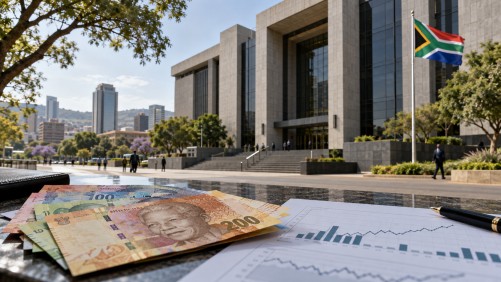
Amidst economic challenges marked by a contraction of 0.2% in the second quarter, the South African Reserve Bank (SARB) has taken a decisive step to address inflation pressures by raising its benchmark repo rate. The rate has been increased by 25 basis points to 7.25%, with the prime lending rate now at 10.75%. This move, endorsed unanimously by the Monetary Policy Committee (MPC), is a response to heightened concerns over fuel prices and inflation, factors that could further influence the country’s economic trajectory.
The central bank’s decision comes as fuel prices, a significant driver of inflation, have surged. Although petrol prices had decreased earlier in the year, renewed pressures have resulted in an average under-recovery of R2.83 per litre, suggesting potential future increases at the pump. The SARB anticipates that headline inflation will exceed 5% later this year, continuing into the early part of 2027, before gradually declining to around 3% by the end of that year.
Higher fuel costs are expected to ripple through various sectors, affecting transport, logistics, and manufacturing expenses, while also straining household budgets. Despite these challenges, some relief has been observed in food inflation, which has reached its lowest point since 2010 due to robust harvests and stable meat prices.
Looking ahead, the SARB remains cautious but optimistic about economic growth, projecting a recovery in the latter half of the year. The bank forecasts an annual growth rate of 1.2% with medium-term growth expected to stabilize around 2%. While interest rates are anticipated to remain relatively stable throughout the remainder of the year, future adjustments will be contingent on economic data and inflationary trends.
The next gathering of the Monetary Policy Committee is scheduled for November 19, 2026, where further evaluations will guide subsequent monetary policy decisions. The SARB continues to monitor the balance of risks to ensure economic stability and growth.