
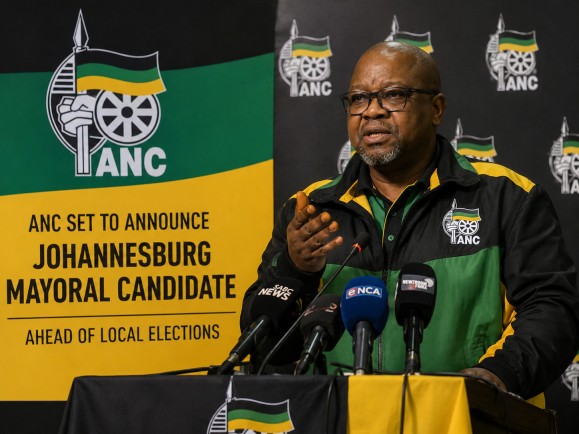
As South Africa approaches its local government elections on November 4, the African National Congress (ANC) is gearing up to announce its candidate for the position of Johannesburg mayor. The city, a pivotal metropolitan municipality in the country, is set to be one of the most hotly contested areas. Currently, Johannesburg is under the leadership of an ANC-led coalition with Dada Morero as the executive mayor. However, Morero’s future in this role is uncertain after he lost his position as the ANC’s Greater Johannesburg regional chairperson in 2025. This development prompted the party to initiate a broader candidate-selection process following an initial nomination that did not align with national standards.
Among the frontrunners for the ANC’s mayoral candidacy is Reverend Frank Chikane, who has gained significant attention after the party conducted interviews with various potential candidates. Meanwhile, other prominent political parties have already announced their candidates for the upcoming elections. The Economic Freedom Fighters (EFF) have put forward Dr. Tlaleng Mofokeng, while ActionSA has backed former Johannesburg mayor Herman Mashaba. Additionally, the Democratic Alliance (DA) has chosen Helen Zille, who has previously served as both the mayor of Cape Town and the premier of the Western Cape.
The Inkatha Freedom Party (IFP) entered the race with Mlungisi Mabaso as their nominee. Other smaller parties, including Rise Mzansi, Build One South Africa (BOSA), the Land Party, and Al Jama-ah, have also declared their candidates, adding to the competitive political landscape. This election cycle is anticipated to heavily emphasize issues such as service delivery, infrastructure improvements, water and electricity supply, housing, crime reduction, and local economic development, all of which are crucial to the residents of Johannesburg.
In light of these upcoming elections, political dynamics within Johannesburg are expected to shift, reflecting broader national trends and priorities. With the ANC’s decision still pending, the political landscape in Johannesburg remains a compelling focal point for both the party and its rivals. The outcome will not only influence local governance but also indicate the broader political sentiment across South Africa as the elections approach.